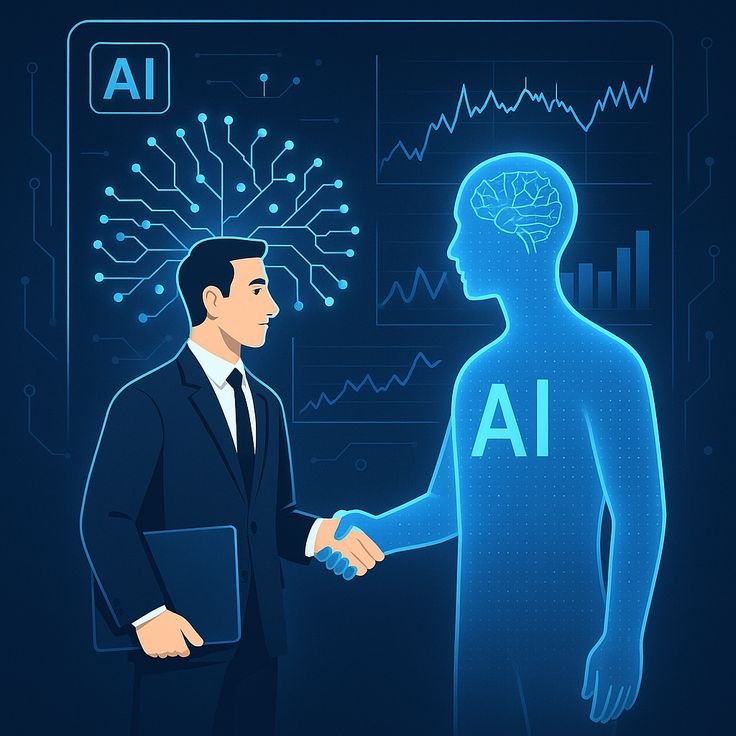
Imagine walking into your kitchen on a chilly morning, asking your speaker to play your favorite upbeat playlist, and having your coffee maker fire up automatically because it knows your usual routine. Or picture scrolling through your phone and effortlessly finding that exact photo of your dog chasing a Frisbee from three summers ago, even though you never tagged it.
That isn’t magic. That is Artificial Intelligence (AI) quietly running in the background of your everyday life.
For a long time, AI sounded like something straight out of a Hollywood sci-fi movie—think cold, calculating robots taking over the world or flying cars navigating neon-lit cities. But in reality, AI is much closer to home. It is software, code, and smart algorithms designed to solve problems, recognize patterns, and learn from data.
If you have ever felt a little intimidated by the hype around AI, you are in the right place. Let’s break down what AI actually is, how it works, and why it matters, minus the confusing jargon.
What Exactly Is AI?
At its core, Artificial Intelligence is the practice of teaching computers to think, learn, and act like humans.
Normal computer programs follow strict, hard-coded rules. If you tell a calculator to add 2 plus 2, it does it the exact same way every single time because a programmer wrote a rule for it. It cannot improvise.
AI, on the other hand, handles tasks that usually require human brainpower. Instead of being given a step-by-step rulebook, an AI system is fed massive amounts of data. It looks for patterns, makes its own connections, and improves over time through trial and error.
Think of it like teaching a toddler what a cat looks like. You don’t hand the child a textbook definition detailing whisker length and ear shape. Instead, you point at cats and say “cat” every time you see one. Eventually, after seeing a few dozen cats, the toddler can spot a cat on the street all by themselves, even if they have never seen that specific breed before. AI works in a very similar way.
A Quick Peek Under the Hood: How AI Actually Works
You don’t need a degree in computer science to grasp the basics of how AI functions. It all boils down to a few key concepts:
1. Data is the Fuel
AI cannot learn in a vacuum. It needs data—and lots of it. If you want an AI to spot fraudulent bank transactions, it needs to study millions of past transactions to understand what normal spending looks like versus what a scam looks like.
2. Machine Learning (ML)
This is the engine driving most modern AI. Machine Learning is a technique where computers use data to learn without being explicitly programmed for every single outcome. The more data the system processes, the sharper and more accurate its predictions become.
3. Deep Learning and Neural Networks
A step beyond basic machine learning, Deep Learning mimics the interconnected structure of the human brain. It uses layers of artificial “neurons” to process complex data. This is the heavy-duty tech responsible for jaw-dropping capabilities like self-driving cars navigating busy streets, real-time voice translation, and generating realistic digital art from a simple text prompt.
Where Do You See AI Every Single Day?
Chances are, you have interacted with AI a dozen times today before even getting out of bed. Here are a few everyday places where AI is quietly doing the heavy lifting:
- Streaming Recommendations: Ever wonder how Netflix or Spotify always seems to know what movie you want to watch or song you want to hear next? They analyze your past choices alongside the habits of millions of other users to predict your taste.
- GPS Navigation: Apps like Google Maps or Waze don’t just show you a map; they track live traffic patterns, construction zones, and accidents in real-time, constantly recalculating the fastest route to get you home.
- Smartphone Cameras: When you snap a picture of a sunset on your phone, AI instantly tweaks the lighting, sharpens the details, and balances the colors before you even look at the final image.
- Smart Assistants: Siri, Alexa, and Google Assistant rely on Natural Language Processing (a branch of AI) to understand your spoken words, figure out your intent, and pull up the weather or set a timer.
The Different Flavors of AI
Not all AI is built the same way. When people talk about artificial intelligence, they usually categorize it into a few distinct stages:
Narrow AI (Weak AI)
This is the only type of AI that exists today. Narrow AI is designed to perform one specific job exceptionally well. A chess-playing computer can beat the world grandmaster, but if you ask it to brew a cup of coffee or write a poem, it will crash. Facial recognition software, spam filters, and language translators are all great examples of Narrow AI.
General AI (Strong AI)
This is the kind of AI you see in movies—a machine with human-level consciousness, capable of reasoning, learning, and adapting across any intellectual task. General AI does not exist yet, and experts heavily debate whether we will ever truly build it.
Superintelligence
This is a purely theoretical stage where AI surpasses human intelligence across every single domain. While fascinating for science fiction writers, it remains firmly in the realm of speculation for now.
The Good, the Bad, and the Real: Challenges of AI
Like any powerful tool, AI comes with plenty of perks, but it also brings real challenges that society is actively trying to solve.
The Benefits
- Speed and Efficiency: AI can crunch mountains of data in seconds, freeing humans from tedious, repetitive admin tasks.
- Medical Breakthroughs: Researchers use AI to analyze medical scans earlier, speed up drug discovery, and track the spread of diseases.
- 24/7 Problem Solving: Automated systems can monitor industrial equipment, customer service requests, or cybersecurity threats around the clock without getting tired.
The Concerns
- Bias and Fairness: Because AI learns from human-generated data, it can accidentally pick up and amplify human prejudices. If an AI hiring tool is trained on decades of biased hiring data, it might unfairly screen out qualified candidates.
- Job Market Shifts: Just like the industrial revolution changed the nature of manual labor, AI is shifting the landscape of office and creative work, requiring people to learn new skill sets.
- Misinformation: With tools that can easily generate hyper-realistic fake images, videos, and text, telling what is real from what is fake has become trickier than ever.
Where Is AI Headed Next?
We are living through a massive turning point in technology. AI is moving from being a novelty tool into an everyday collaborator. In the near future, we will likely see more advanced healthcare diagnostics tailored to your specific DNA, smarter energy grids that cut down on waste, and personal assistants that can manage complex multi-step projects for you.
The goal isn’t to replace human creativity and intuition, but to amplify it. AI takes care of the data crunching and pattern matching so that we can focus on what humans do best: empathy, big-picture strategy, and creative problem-solving.
Understanding AI doesn’t require a background in math or computer science. At its heart, AI is simply a mirror of human curiosity—built by us, trained on our history, and designed to help us figure out what comes next.